

Principal Investigator:
Zhen Zhao, Professor of Clinical Pathology and Laboratory Medicine
Background & Unmet Need
- Preeclampsia is a serious hypertensive disorder of pregnancy that typically occurs ≥20 weeks of gestation and affects 2-8% of pregnancies worldwide
- Preeclampsia is the third leading cause of maternal mortality in the U.S., and ~10% of perinatal death is due to pregnancy complicated by preeclampsia
- Early interventions, such as low-dose aspirin, may be useful for preventing pre-term preeclampsia in at-risk women, but screening is challenging as many patients are asymptomatic
- Existing prediction methods largely depend on non-specific laboratory testing, clinical judgment and specialized knowledge, which may restrict their accessibility across different healthcare settings
- Moreover, the best predictive biomarker, the SFIt/PIGF ratio, has limited positive predictive value and is primarily used to rule out the condition
- Unmet Need: Early, accurate, and universally accessible methods to predict preeclampsia
Technology Overview
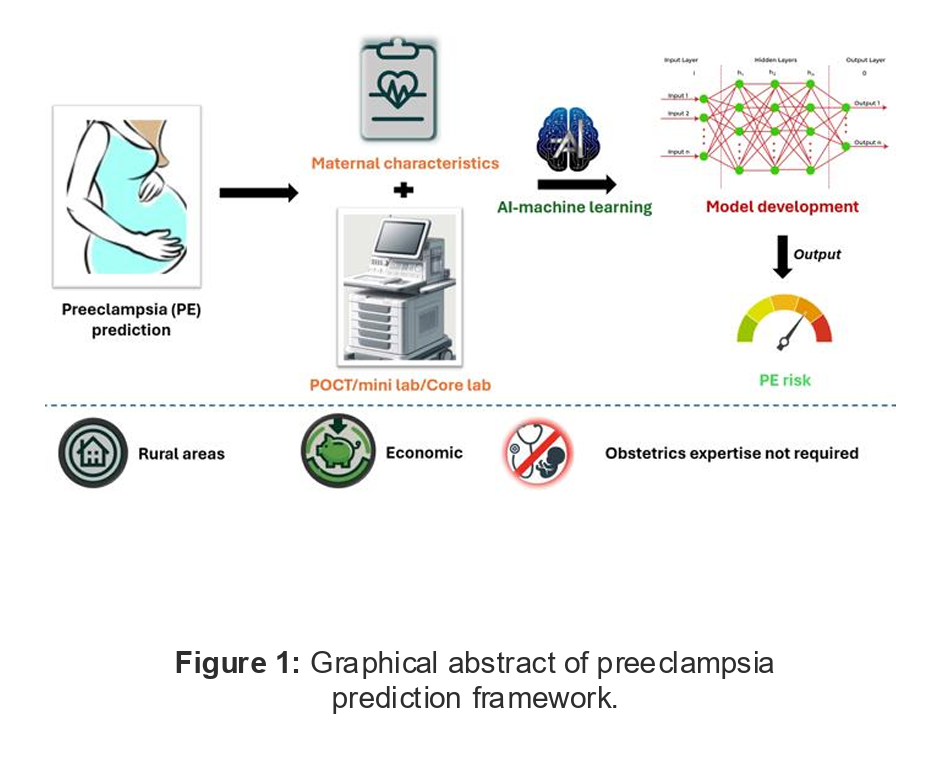
- The Technology: Integrated system combining blood testing and predictive modeling using AI and machine learning algorithms to accurately predict the risk of preeclampsia in pregnant women
- The model integrates data on maternal characteristics (e.g., age, race, gestational age, medical history) and routine lab results (e.g., CBC, basic metabolic panel, urine protein analysis)
- The model generates a rolling risk estimates at different gestational age windows between 28-40 weeks, forecasting preeclampsia onset within 1, 2, and 4 weeks
- This provides dynamic, short-term prediction of preeclampsia in late gestation using routine data
- PoC Data: The model was trained on ~36k patient records across three demographically distinct hospitals, achieving rolling AUCs between 0.75-0.88 across gestational weeks from 28 to 40
Technology Applications
- Routine prediction of preeclampsia in both acute clinical and routine prenatal care settings to facilitate early intervention
- Integration with EHR or telehealth platforms for continuous monitoring of high-risk patients
- Use as a research tool to analyze patterns and outcomes for preeclampsia
Technology Advantages
- Exclusively uses standard clinical lab results and patient data, streamlining integration with existing EHR systems
- Output does not require specialized interpretation by obstetrics providers, increasing utility in low resource or rural settings
- Provides real time processing and results to inform care
Publications
Resources

Intellectual Property
Patents
- PCT Application Filed WO2026036063: Technologies for Integrated Point-of-Care Testing and AI-Powered Adverse Pregnancy Outcomes Prediction
Cornell Reference
- 11166
Contact Information

For additional information please contact
Donna Rounds
Associate Director, Business Development and Licensing
Phone: (646) 780-8775
Email: djr296@cornell.edu