

Principal Investigator:
Amirhossein Goldan, Associate Professor of Electrical Engineering in Radiology
Gloria Chiang, Professor of Radiology
Background & Unmet Need
- Traditional PET imaging requires patients to lie flat for extended periods, causing discomfort and requiring significant immobilization
- Conventional PET setups are large, fixed installations requiring dedicated scanner rooms, workstations, and technician operation rooms
- Current systems lack mobility and flexibility, limiting their use in outpatient or non-traditional settings
- Unmet Need: A mobile, self-contained PET imaging system that can accommodate patients who cannot lie flat without compromising image quality
Technology Overview
- Technology: A portable, upright PET imaging system featuring integrated motion tracking and augmented reality capabilities, designed for seated or partially reclined imaging positions.
- A prototype system has been designed and constructed to validate the concept
- The system features a compact upright gantry mounted on a mobile cart with an integrated foldable chair
- Real-time electromagnetic tracking enables sub-millimeter motion correction during scanning
- Built-in lead shielding provides radiation protection for nearby personnel
- An integrated AR headset enhances patient engagement and comfort during procedures
- A comprehensive control center manages synchronized data acquisition and system monitoring
Technology Applications
- Outpatient PET imaging in non-traditional settings, such as clinics or mobile diagnostic units
- Dynamic imaging studies requiring patient interaction or movement
- Clinical applications requiring upright positioning, including patients who need head movement flexibility or cannot lie flat (such as pediatric cases or those with specific medical conditions)
Technology Advantages
- Enhanced mobility and flexibility - can be wheeled to any location as a self-contained unit
- Improved patient comfort and accessibility through upright positioning
- Superior image quality despite patient movement through real-time motion correction
- Reduced space requirements compared to traditional PET installations
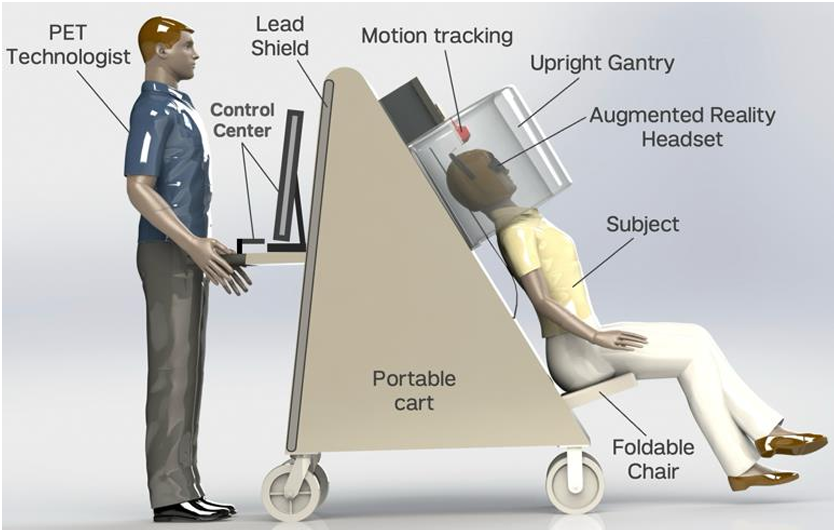
Figure: Rendering of the mobile PET system featuring an upright gantry mounted on a portable cart. Key components include a foldable patient chair, integrated lead shielding, motion tracking system, augmented reality headset, and control center for the PET technologist.
Resources

Intellectual Property
Patents
- Provisional Application Filed
Cornell Reference
- 11338
Contact Information

For additional information please contact
Donna Rounds
Associate Director, Business Development and Licensing
Phone: (646) 780-8775
Email: djr296@cornell.edu